
The starting point
The Norwegian project established a useful type of product: explain an unfamiliar property market and help a reader formulate a concrete enquiry. Sweden offers a related audience, but the process and practical questions are its own.
The question was which parts of the first product could be reused and which needed new research. Sharing infrastructure is useful only if it does not flatten the differences between the markets.
What we built
Keep the buyer’s questions local
The Swedish resource has its own guidance about the country and purchase process. Market-specific content provides the reason to visit; the familiar structure helps readers find their way through it.
Reuse the connections behind the pages
The project shares an operating approach with the Norwegian site: publishing, enquiry intake and maintenance work can build on the same capabilities. Reuse happens in the supporting system while the public information remains specific to Sweden.
Make maintenance part of publishing
The earlier project account describes a scheduled content loop that initially lacked a record of its own decisions. The response was to retain the expected outcome and review date of changes, so the next cycle could examine earlier work before producing more.
The same structure has to earn its place in Sweden.
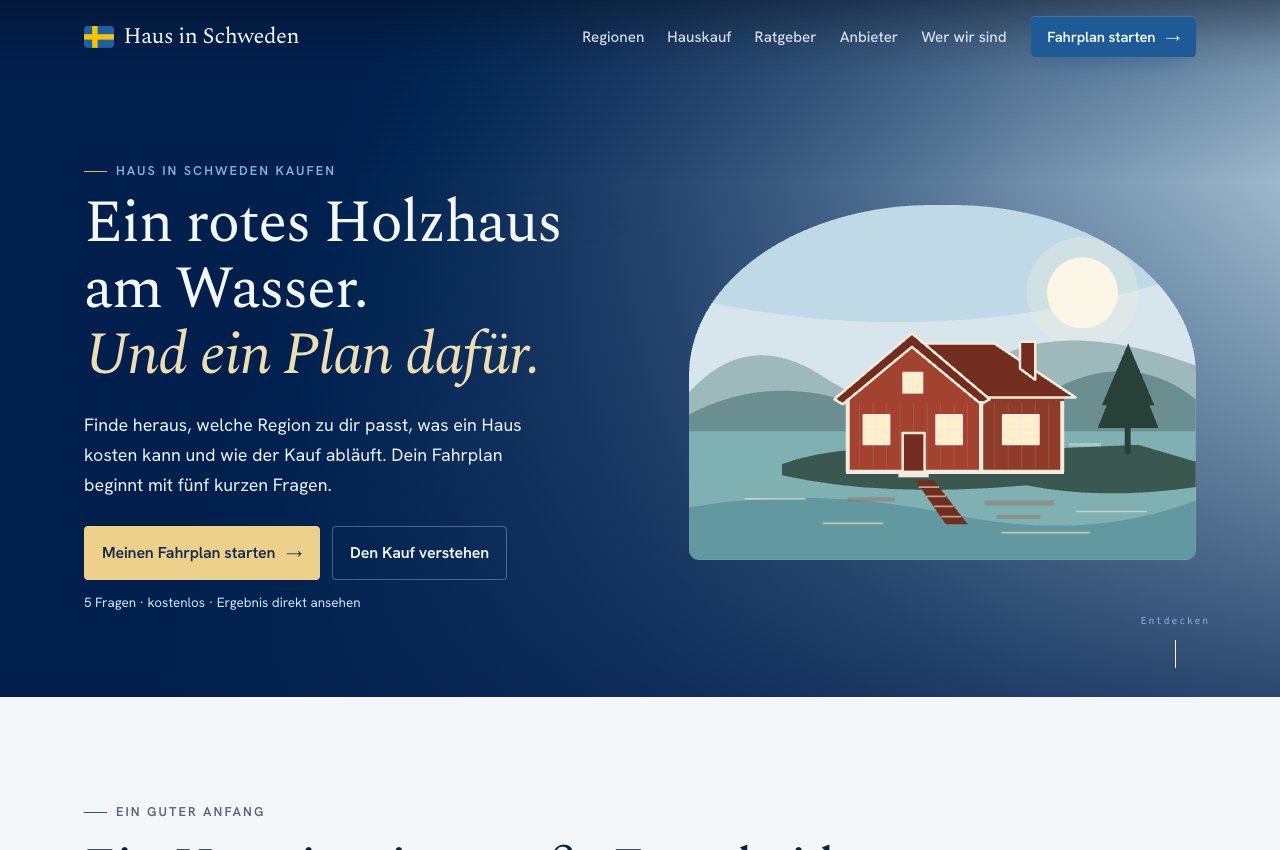
The public Swedish site presents region exploration, a purchase-process introduction and a short planning flow. Those are familiar product components, but their content has to answer the Swedish question. A shared layout does not make Norwegian facts transferable.
This is where the adjacent-market approach becomes concrete. A publishing system or intake connection can be reused; country guidance still needs its own sources and editorial review. The pair of sites is useful as an operating example because it separates the reusable capability from the knowledge that must be maintained locally.
How it works
- 01
Find the relevant country guidance
Start with a Swedish property question.
- 02
Put the options in context
Read the process and practical orientation.
- 03
Make a specific enquiry
Explain what is being considered and what help is needed.
What exists today
A second buyer resource
A separate public product for the Swedish market.
Shared operating approach
Publishing and intake work can reuse common capabilities.
A documented lesson
The founder’s account of the publishing loop is available as a Thought.
What the work taught us
A system that runs every week does not necessarily improve every week. To learn, the next run needs the previous action, the expectation and the result. That distinction became the subject of “Loops Don’t Learn”.
The useful evidence may also sit outside the newest page. The previously published project account describes finding valuable older search paths and addressing their routing. Maintenance can matter more than publishing another article.
Read the related Thought →Sources and scope
The operating lessons refer to the founder’s published project account. They are not a fresh measurement of traffic, costs or enquiry conversion. Market-specific offers and information live on the product site.
Public product pages checked and case text updated on . Historical founder accounts retain their original context.