
The starting point
Several products create recurring versions of the same work: record an enquiry, generate an asset, notice a failure, preserve a decision and inspect what changed. Rebuilding each connection independently creates more systems to maintain.
Deimann OS is the name for the shared layer that grew from that work. Its value lies in useful capabilities and the connections between them, rather than a single packaged application.
What we built
Share the working capabilities
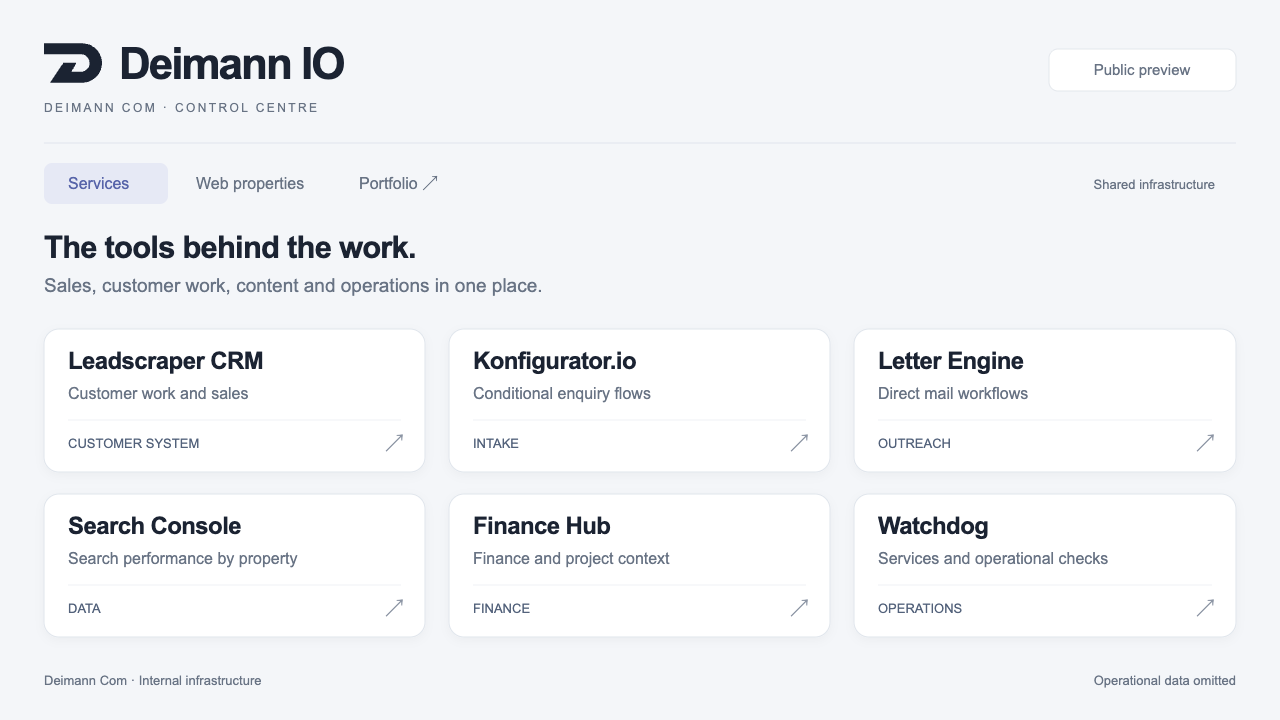
Konfigurator.io provides conditional enquiry flows. The Lead Inbox records source context and requests. Monitoring and search tooling help us inspect operations. These capabilities can be used across products, with coverage varying by service.
Use AI within a defined task
ChatGPT, Codex and Claude support research, writing, engineering and operating work. Repository documentation and reusable context carry decisions between sessions. Permissions and reviews depend on the action, and consequential decisions remain a person’s responsibility.
Distinguish an action from its result
A passing build, a deployment, an accepted email and a delivered message are different states. The operating approach keeps that distinction visible so a report does not turn a technical intermediate step into a customer outcome.
An accepted action is not always a completed outcome.
Email provides a practical example of the operating approach. An application can accept a request, an email provider can accept a send, and a later event can report delivery or failure. Treating the first of those as the last would make an internal status look better than the customer’s actual experience.
The website contact receipt follows a defined path through the intake and delivery service. Other products have different configurations. The shared layer is useful when it carries the relevant status and source context while preserving those differences, rather than assigning the same success label to every workflow.
How it works
- 01
Capture the work
Keep the request, source and relevant context.
- 02
Execute with scope
Use the appropriate tool and permission boundary.
- 03
Check the result
Record what happened and what remains unresolved.
What exists today
Shared intake
Common enquiry infrastructure used in the portfolio.
A public tool register
The operating stack names tools and their scope.
Reusable context
Written decisions and repository handovers support recurring work.
What the work taught us
A shared service creates a shared dependency. Reusing a capability reduces duplicated work, but it also means several products can be affected by the same fault. Understanding that trade is part of operating the system.
The other lesson is memory. An agent running on a schedule is useful only if the record of the work can inform what happens next. The operating approach therefore needs outcomes and review dates as well as instructions.
Read the related Thought →Sources and scope
Internal infrastructure, not a software subscription or a product for sale. Automation and monitoring coverage vary by product. The public stack is an operating description, not a claim of universal unattended operation.
Public product pages checked and case text updated on . Historical founder accounts retain their original context.