
The starting point
Finding a fishing guide often means piecing together a personal website, a forum discussion and a social profile. Even when an angler finds a name, the water, target species and type of trip may still be unclear.
Janik’s own fishing experience gave the project a specific starting point: make specialist knowledge easier to find, while keeping the people who know the water at the centre of the product.
What we built
A directory with useful discovery paths
Guide profiles sit alongside routes by country, region and target species. The product helps an angler narrow the question before choosing someone to contact. A profile is more useful when its specialisation is visible than when it is just another name in a list.
Answer the questions around the trip
The public site connects guide discovery with information about waters, fishing licences, techniques and practical calculators. These are different stages of the same visit: understand what is possible, prepare for it and then find appropriate local help.
Keep the information open to correction
The editorial approach includes source information and ways to report errors. A directory changes as guides, websites and rules change. Publication therefore needs a maintenance route as well as an initial research workflow.
The catalogue should answer “where?” as well as “who?”.
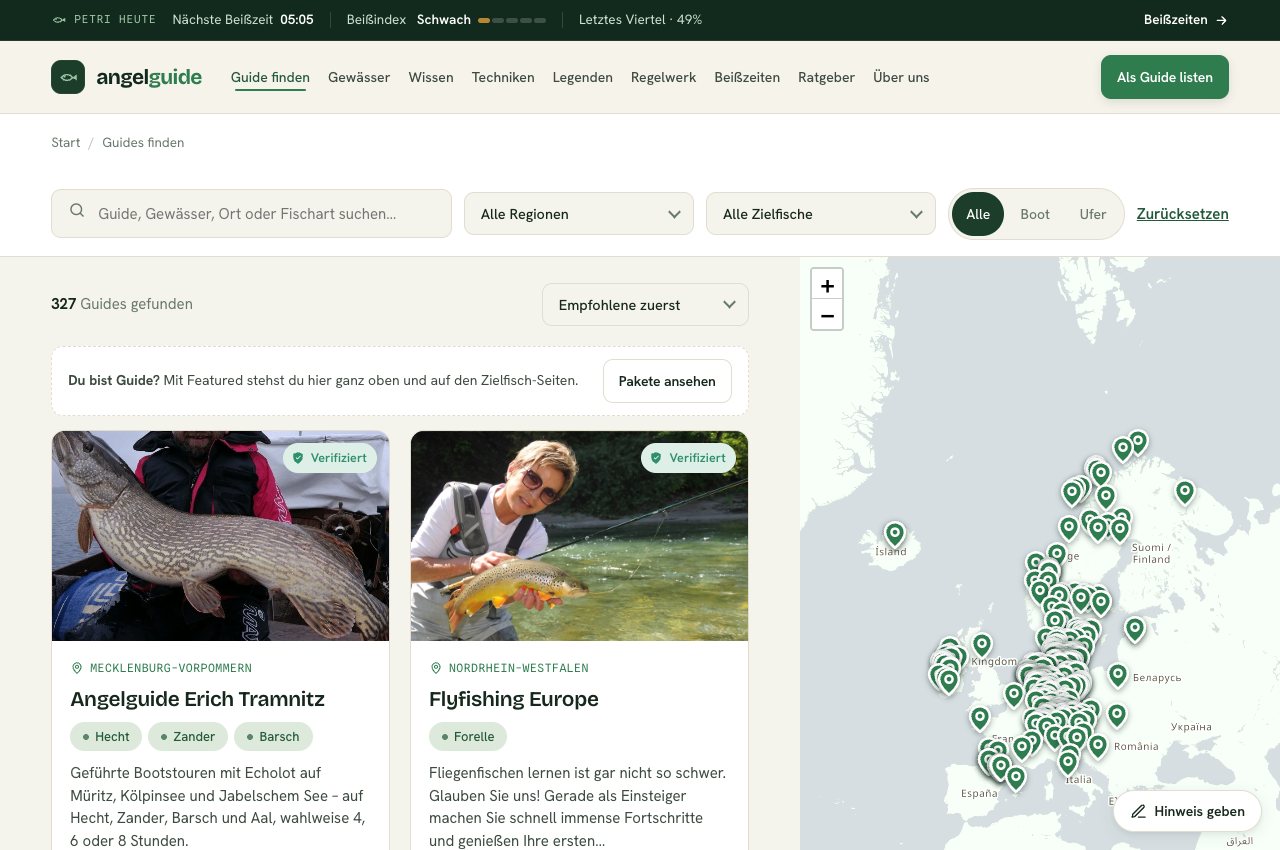
The public guide directory combines a map with profile cards and search controls. A visitor can move between geography, the kind of fishing trip and a guide’s specialisation. The map supplies orientation; the profile supplies the detail that makes contacting a particular guide worthwhile.
Guide discovery is connected to the preparation resources rather than isolated from them. A licence question, an unfamiliar water or a technique can be the first reason someone arrives. Useful links should let that reader continue towards appropriate local expertise instead of starting a second search elsewhere.
How it works
- 01
Choose the fishing question
Start with a place, a species or a practical requirement.
- 02
Prepare the trip
Use the guides, reference content and planning tools.
- 03
Find local expertise
Read a suitable guide’s profile and follow the contact route.
What exists today
Guide directory
Public profiles and several routes into the same catalogue.
Planning content
Guides, waters, techniques and licence information.
Practical tools
Public calculators and preparation resources.
What the work taught us
A directory becomes useful when the surrounding questions are answered too. Someone who cannot work out the licence requirement is not ready to choose a guide. Editorial content and discovery are parts of one product.
This also changes the publishing priorities. The most useful page may be a careful answer to a narrow question. The project needs specialist context and ongoing corrections more than an endless supply of generic articles.
Sources and scope
The public directory is a discovery product. This case does not claim booking volume, sponsor revenue or a measured increase in traffic. Guide availability and trip arrangements must be checked with the guide.
Public product pages checked and case text updated on . Historical founder accounts retain their original context.