
The starting point
An employer can do good work without being the loudest name in a candidate’s search. A smaller company needs to explain what working there is actually like, while a candidate needs a way to compare more than advertising claims.
The project follows Janik’s recruiting work at Leantree. It addresses an earlier point in the decision: choosing which employer deserves attention before applying for a role.
What we built
Give the assessment a visible method
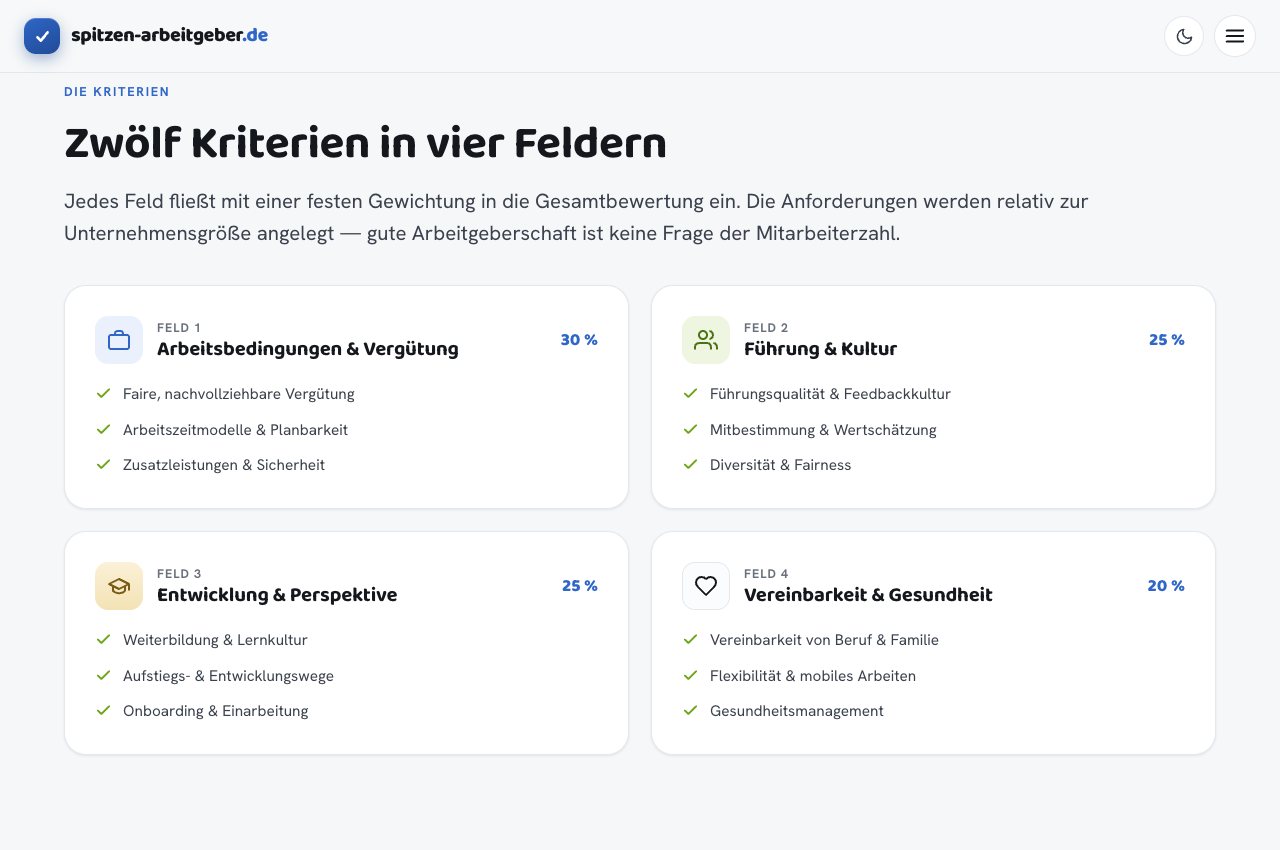
The product publishes twelve criteria across four areas: working conditions, leadership, development, and the compatibility of work with personal life and health. The published method explains weighting and the decision process rather than presenting the seal without context.
Separate an application from an award
The public process starts with an employer application. The methodology describes evidence, anonymous employee feedback, plausibility checks and a decision. A submission is the start of that process; it is not itself a positive assessment.
Turn the result into a useful public profile
The product combines employer discovery with profiles and an explanation of the recognition. Candidates get a route to learning about a company; employers get a way to present the substance behind their positioning.
A seal needs an explanation that survives a closer look.
The methodology page shows how the assessment areas relate to each other and describes the evidence process. A candidate can read the criteria; an employer can understand what information it will need to provide. Publishing the method makes the offer more concrete than a recognition badge on its own.
The public methodology also distinguishes a sample report from an actual employer result. That distinction carries into this case: the screenshot shows the assessment framework, not evidence that a named customer has passed it. The application, assessment and resulting public profile are separate stages.
How it works
- 01
Apply with context
Provide information about the workplace.
- 02
Review against the method
Use the published criteria and stated evidence process.
- 03
Explain the outcome
Show the profile and recognition when awarded.
What exists today
Published criteria
Twelve criteria grouped into four assessment areas.
Employer intake
A public route to request an assessment.
Discovery layer
An employer directory alongside practical HR content.
What the work taught us
A recognition product needs readers to understand the basis of the recognition. The assessment method, the validity period and the route to a decision are therefore product content, not details hidden behind a badge.
Growth also depends on two groups finding the platform useful: employers willing to provide evidence and candidates willing to read it. The work is to make the explanation useful to both.
Sources and scope
This case describes the platform and its published methodology. It does not certify a particular employer or independently verify each completed assessment. The product site contains the current participation process.
Public product pages checked and case text updated on . Historical founder accounts retain their original context.