
The starting point
A large contact list can still leave a sales team with the difficult work: deciding which companies fit the offer, finding the right person and understanding why it is worth reaching out. A row in a database is only a starting point.
The product grew from the founder’s experience of buying lead tools. The useful question became how to research an actual market request and return a result that a customer can inspect, rather than treating the size of the list as the result.
What we built
Start with the offer and market
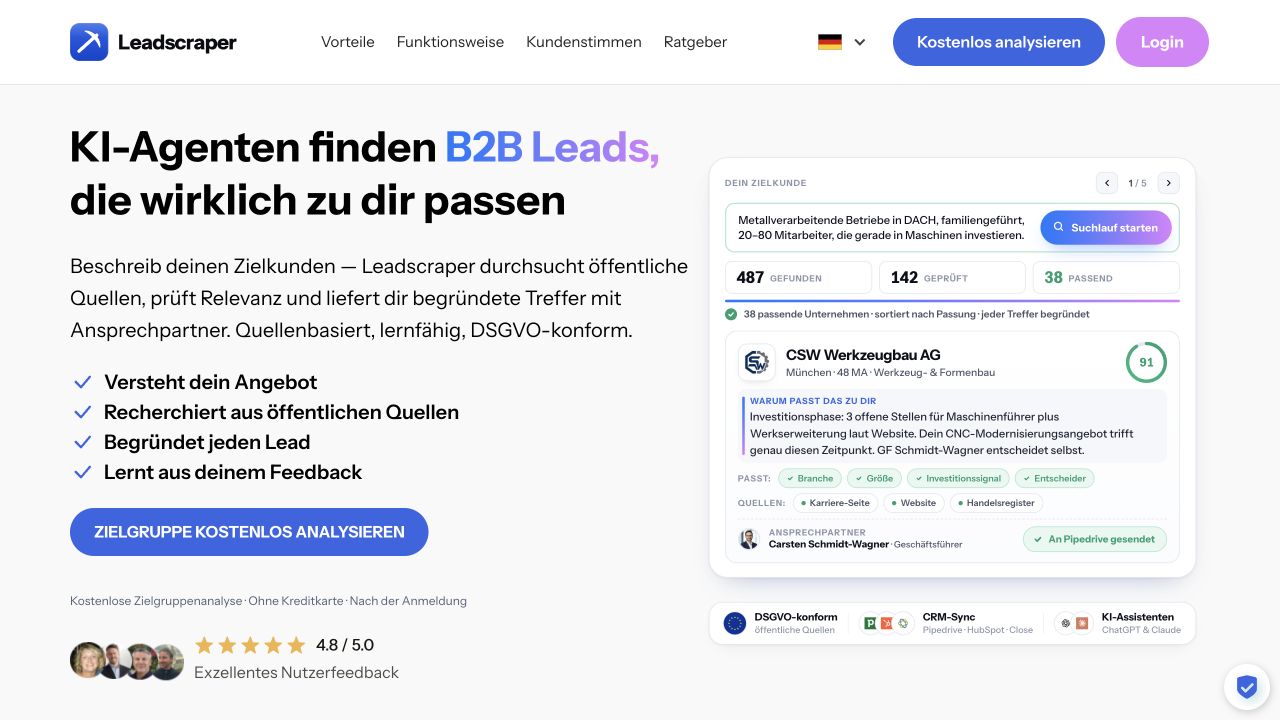
The public product describes a workflow that turns a website or a written description into search criteria. Region, company characteristics and the intended contact shape the research, rather than being added after a generic list has been produced.
Show the evidence behind a result
Company and contact research uses public B2B sources. Source links and matching explanations help a user inspect the result and understand uncertainty. They provide a route to checking a suggestion instead of asking the user to accept a black box.
Connect research to the sales workflow
The software offer includes lead feedback and export into the customer’s next process. Managed acquisition work is scoped separately: choosing a segment, researching companies and preparing the route to outreach need responsibility beyond a CSV file.
The reason for a match belongs beside the contact.
A request for companies in a particular region and industry needs more than an industry label. The user needs to see which criteria are supported, where the information came from and which contact is relevant to the intended conversation. That is the product problem behind the matching explanation.
The public product presents company details, contact information and context together. Feedback gives the customer a way to say whether a suggestion fits. Export is the next step, not the definition of success: a usable sales list still needs the customer to inspect its relevance and choose an appropriate outreach process.
Keeping that context with the result also creates a useful support question. Instead of only asking whether a record exists, the team can examine why it appeared and which assumption needs correcting.
How it works
- 01
Describe the market
State the offer, target company and region.
- 02
Inspect the fit
Review companies, contacts and supporting sources.
- 03
Use and review the results
Export suitable records and give feedback on the match.
What exists today
Market context
A public product workflow built around the customer’s offer.
Inspectable suggestions
Source information and explanations accompany the research.
Software and service
Self-service plans alongside a managed acquisition offer.
What the work taught us
The quality of the result matters at the moment the user acts on it. A convincing explanation cannot repair the wrong company or an outdated contact. Research, feedback and source inspection therefore belong in the product itself.
The same applies to how the business is described. Product positioning, technical behaviour and the explanation of data processing have to agree. Customers need to know what is researched, what is verified and what they still need to review themselves.
Read the related Thought →Sources and scope
This case describes the public product and operating approach. No customer conversion rate, campaign outcome or current revenue figure is attributed to it here. Current plans and terms are on the product site.
Public product pages checked and case text updated on . Historical founder accounts retain their original context.