
The starting point
A small digital business can be valuable without looking like a conventional company. A buyer needs to understand how it earns, what depends on the owner and what work will remain after the sale. A domain name and a revenue headline do not answer those questions.
At the same time, a seller should not have to put private financial information on a public landing page to begin a conversation. The product has to explain enough to create interest and preserve a controlled route to the details.
What we built
A public introduction with a clear status
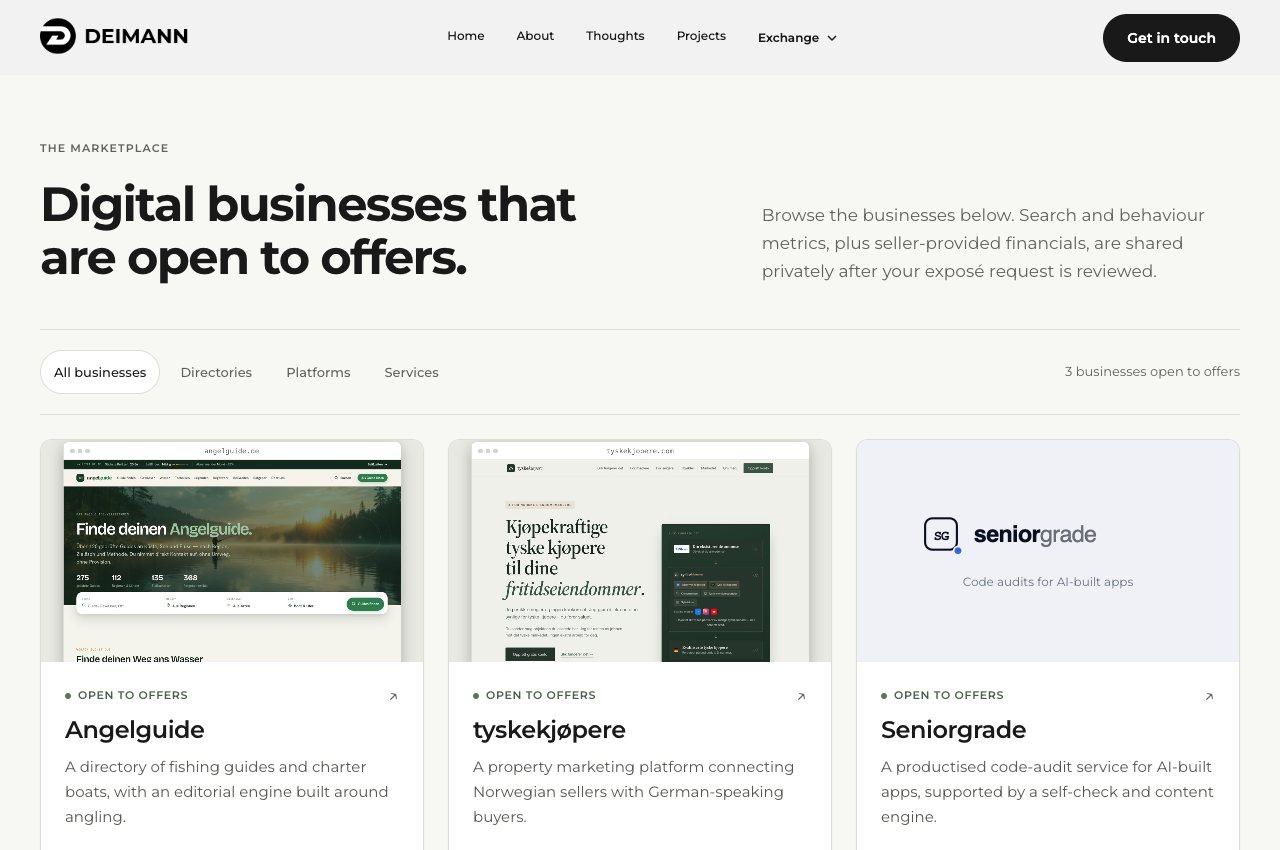
The catalogue describes the business, its category, language, seller and whether it is open to offers. Public pages give readers an entry point. Structured catalogue data and an agent guide explain how the fields should be interpreted.
A brief before a sales conversation
The Konfigurator.io assessment turns the owner’s inputs into indicative earnings scenarios and a downloadable business brief. No email address is needed to obtain that local result. An optional request then starts a personal review.
Private details through reviewed access
Exposé requests and assessment enquiries are reviewed by a person. The public website does not publish private financial fields. Access to an exposé gives a buyer information for their review; it does not replace due diligence or create an acquisition agreement.
Public discovery and private diligence are different products.
The public catalogue makes a business findable without publishing its private financial fields. A reader can see its model and status; the controlled buyer process provides the detail needed to examine the opportunity. Those two views are built for different stages of the decision.
The same distinction appears in the public data. The agent guide explains the meaning of a listing status, identifies seller-provided information and treats unavailable private metrics as unknown rather than zero. A machine reading the catalogue should not turn an introduction into a verified financial assessment.
This is also why the assessment asks for a personal review separately. Preparing a brief is useful work the software can do immediately. Reviewing an owner’s circumstances and deciding what information to release remain separate tasks.
How it works
- 01
Understand the business
Read its public model, seller and status.
- 02
Request the relevant detail
Ask for a review or controlled buyer access.
- 03
Review before committing
Examine the underlying records and agree transaction terms separately.
What exists today
Public catalogue
Readable business introductions and documented status fields.
Seller brief
A local result before the optional contact step.
Controlled access
Human review before private business information is released.
What the work taught us
The important automation boundary is the decision to expose information or recommend a course of action. Calculations and a clean interface can prepare that decision. They do not make a seller’s inputs independently verified.
Building Exchange inside deimann.com also forced a practical improvement: one navigation, one visual system and one account of who operates the service. The buyer process can be distinct without making the marketplace feel like an unrelated company.
Read the related Thought →Sources and scope
Valuation and listing currently have no fixed fee. The seller pays 10% of the purchase price when a sale closes; buyers currently pay no fee. A published listing is not evidence of a completed sale.
Public product pages checked and case text updated on . Historical founder accounts retain their original context.